New commission of enlarged Katharine Lane Weems’ cat sculpture to be installed ahead of
Cape Ann Museum’s June 30 reopening
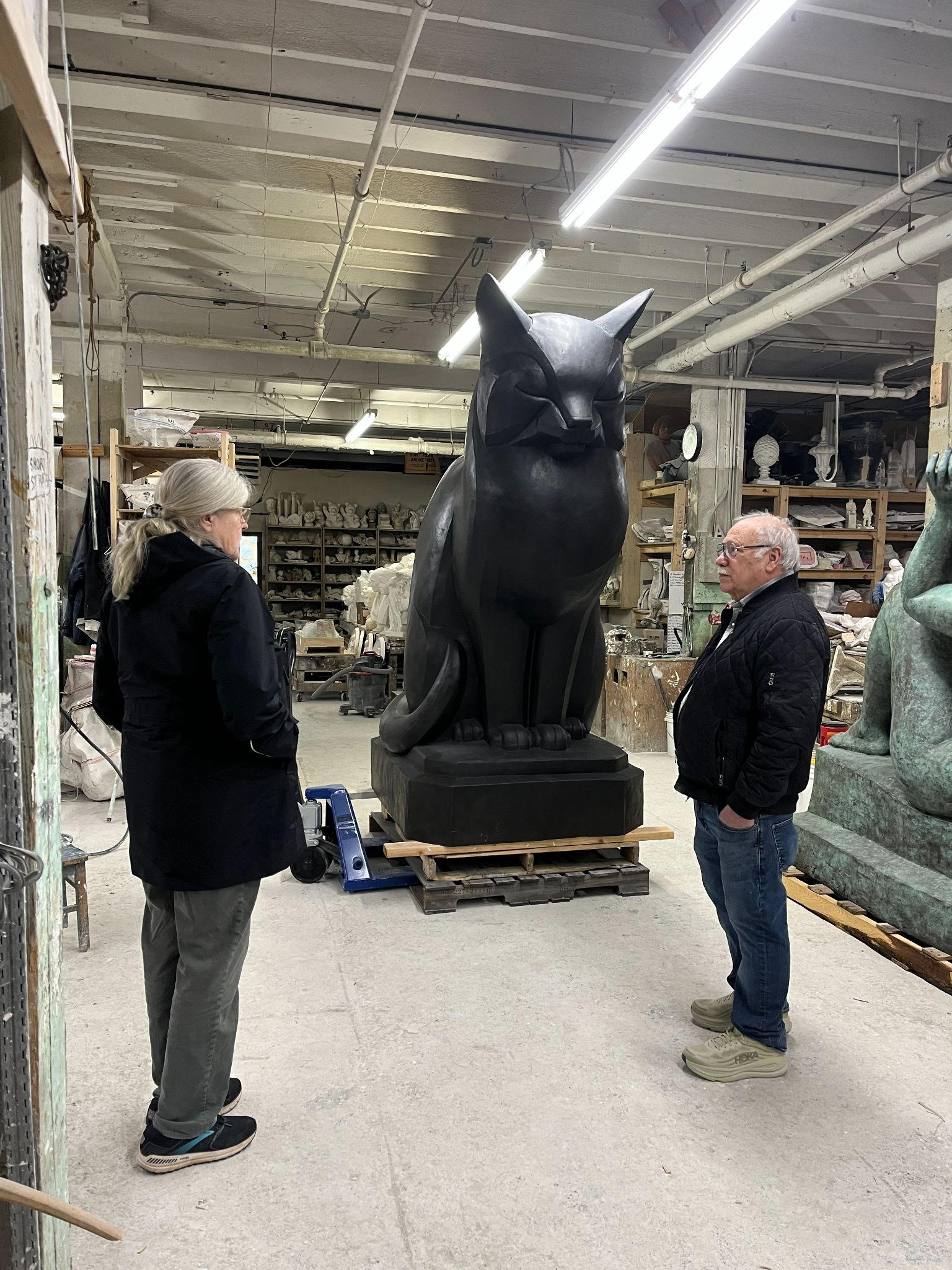
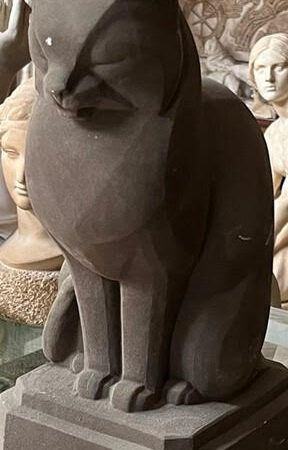
Left: Katharine Lane Weems, Seated Cat (Sphinx), Modeled in 1941.
WHAT: As part of Cape Ann Museum’s reopening following nearly 20 months of closure and the success of a $23 million fundraising campaign, a new commission of Seated Cat (Sphinx) by Katharine Lane Weems will be installed in the Museum’s renovated granite courtyard.
The new sculpture represents a significant enlargement of Weems’s original 1941 work: the resulting bronze cat stands 8 feet tall (10 feet including its base) and was modeled directly from the original sculpture, which measures approximately 18 inches in height. The enlarged version was created by Robert Shure of Skylight Studios in Woburn. Shure worked closely with Weems on many projects during the artist’s lifetime. The Museum has invested more than $100,000 to enlarge the piece and fabricate it on a monumental scale, to honor Weems’ legacy as one of Cape Ann’s most significant sculptors of the 20th century.
WHEN: Installation by crane on Friday, May 15 around 10:00 a.m. in Gloucester. Pickup of sculpture to move to Gloucester on Thursday, May 14 around 2:30 p.m. at Skylight Studios, 105 Salem Street in Woburn.
WHERE: Installation location: Cape Ann Museum’s Downtown Campus Granite Courtyard, 27 Pleasant St., Gloucester MA
WHO: Katharine Lane Weems (1899–1989) was one of a handful of early 20th-century women sculptors in America. She was born into a wealthy Boston family who maintained a summer estate in Manchester-by-the-Sea, Massachusetts. Their Manchester property included the house (nicknamed “The Chimneys”) and an adjacent studio. Between 1918 and 1919, Weems studied sculpture under Charles Grafly at the School of the Museum of Fine Arts in Boston. Grafly who also spent time on Cape Ann was the preeminent portrait sculptor of the time. In addition to teaching Weems, Grafly provided instruction to Walker Hancock, George Demetrios, Paul Manship, and Amelia Peabody, among others.
Through her work with fellow Cape Ann sculptor, Anna Vaughn Hyatt Huntington, Weems perfected the art of portraying animals in clay, a passion for which she was widely recognized. One of her earliest successes was her 1927 bronze Narcisse Noir, now at the Museum of Fine Arts, Boston, which earned her the prestigious Widener Gold Medal from the Pennsylvania Academy of the Fine Arts.
Locally, Weems is most closely associated with her bronze rhinoceroses at Harvard University’s Biological Laboratories, a commission she received in 1930, and her 12-foot-long group of Dolphins, later installed at the New England Aquarium in 1979.
LINK TO KATHARINE LANE WEEMS WORKS IN THE CAPE ANN MUSEUM COLLECTION