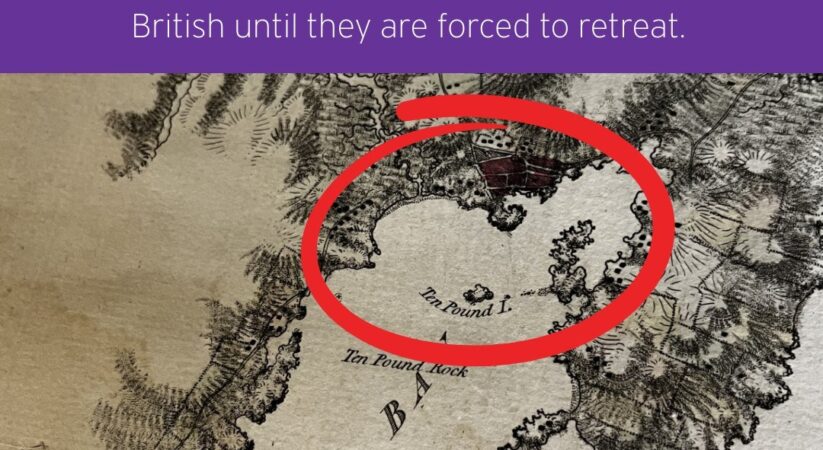

Did you know that Gloucester, Massachusetts, was the site of a skirmish during the early days of the Revolutionary War? This chart from 1780 shows the scene of action.
In the days leading up to the event, Captain John Linzee, who commanded the British sloop-of-war Falcon, went on a tear around Cape Ann. His mission was to interrupt American trade by going after ships and seizing any cargo found aboard for the British.
On August 8, 1775, the Falcon’s crew spotted two trading vessels. The first of the ships was easily captured, but the second schooner took off to Gloucester Harbor.
Linzee followed into the harbor in hot pursuit. As he directed smaller boats out to capture the grounded schooner, Gloucester militiamen fired a consistent and devastating volley at them from the shore. In response, Linzee fired the Falcon’s cannons at Gloucester and even sent his men to try to set fire to the town. The British attempts to deter the local militiamen’s assault failed, and they were forced to retreat in a withering defeat.
And the greatest irony? Linzee had to leave behind the two schooners he had set out to capture. Several of his own men were captured instead!
Linzee laid out more details of the event in an August 10th report to his superior, Vice Admiral Samuel Graves. A copy of the letter is included in a bound volume, “Naval documents from the American Revolution 1774-1775,” in the MHS collection.
 : A detail of Gloucester Harbor from a chart in The Atlantic Neptune. Volume 4. London: c. 1780.
Join us as we commemo